
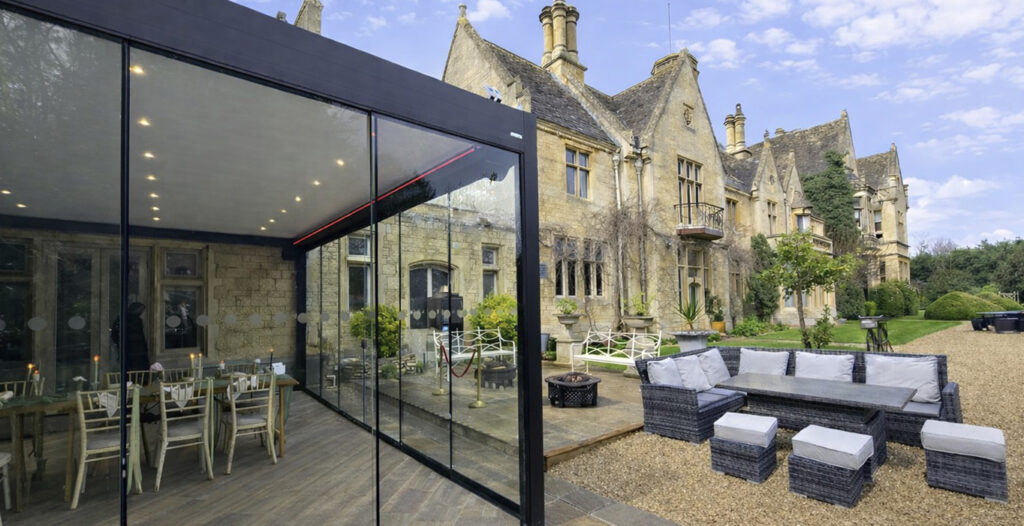
A pub with a 50-cover beer garden loses roughly 80–110 trading days a year to wind, rain and low temperatures. A restaurant with an alfresco terrace watches those covers sit empty for months at a time. A hotel with an exposed poolside loses bookings that a covered equivalent would have kept. The weather problem is well understood. What is less well modelled is the revenue number it represents — and how quickly a covered structure changes it.
This guide covers the commercial case for covered outdoor spaces in the UK hospitality sector: what the revenue opportunity looks like for different venue types, what covering solutions are available for commercial installations, and how the financials typically work out. If you want to model the numbers for your own venue first, start with the calculator below.
Model the revenue opportunity for your venue
The calculator below was built specifically for UK hospitality and venue operators. Enter your cover count or space dimensions, your average spend per head, table turns and trading days — and model the revenue impact of recovering weather-lost days across three scenarios. It also calculates a payback period against a typical installation investment.
Potential Revenue Calculator
Use our bespoke calculator to find out how much additional revenue a covered outdoor space could unlock for your business — all year round, whatever the weather.
Heating, lighting, and other daily running costs for the covered space.
currently lost
Typical installations range £15,000–£60,000 depending on size and specification.
- Weather-lost days × recovery rate gives the number of days targeted by a covered space.
- Those days are then multiplied by a utilisation factor — accounting for shoulder-season demand, not just calendar availability.
- Adjusted spend × table turns × covers gives a recovered revenue figure. A 15% net margin is applied to estimate indicative incremental profit.
*Indicative incremental profit is based on a 15% net margin applied to recovered-day revenue, minus any running costs entered. Recovery rates and spend factors vary by scenario. All projections are indicative only and not a guarantee of revenue.
Calculator built by SEO Strategy for Azure Outdoor Living.
What the numbers typically look like
Running the calculator across common UK venue profiles produces consistent patterns. A 40-cover pub terrace in a moderately exposed location loses around 120 outdoor trading days a year. At £18 average spend and two table turns per day, a covered structure operating across 75% of those days at 95% of normal spend adds approximately £82,000 in recovered revenue annually — against a typical installation cost of £25,000–£45,000. Payback period on the conservative model: under 12 months.
For restaurants with higher spend per head (£35+) and multiple table turns the numbers scale quickly. A 30-cover restaurant terrace losing 100 days a year to weather, recovering 75 of those days at full spend, generates over £95,000 in additional annual revenue. Hotels with poolside terraces and per-head spends above £45 often produce the highest absolute figures — and the strongest case for premium installation specifications.
Wedding venues are a different model entirely. Lower volume, high per-head spend (£60–£100+), and a single uncovered outdoor space that makes certain dates unsellable. A covered outdoor ceremony or reception space does not just recover revenue — it expands the bookable season from roughly 20 weeks to 40 or more.
Covered outdoor space options for commercial venues
The range of covering solutions suited to commercial hospitality use is broader than most venue operators realise. The choice is not simply between a permanent structure and doing nothing — there is a full spectrum of options calibrated to different venue types, planning contexts and budget ranges.
Retractable glass rooms
The most commercially flexible option. A retractable glass room opens fully in good weather and closes completely when conditions deteriorate — giving a venue the outdoor atmosphere without the weather dependency. The Azure Slide system is the most commonly specified commercial product in this category: full retraction, no mid-span posts, clean sightlines that work for hospitality aesthetics. The Cubo is the fixed-frame alternative when a permanent glass enclosure is the brief.
Glass verandas
Glass verandas provide roof coverage without full enclosure — suited to venues where the open-sided feel is important to the offer (beer gardens, gastropub terraces, courtyard dining) but rain and overhead exposure are the primary problem. Lower investment than a full glass room, simpler planning position in most cases, and faster installation.
Bioclimatic pergolas
Bioclimatic pergolas use adjustable louvred blades to modulate light, airflow and rain protection. They read as outdoor structures — aesthetically lighter than a glass room — and are well-suited to venues where the outdoor character of the space is a commercial asset. The Lusso and Puro systems are specified for commercial use and carry the structural ratings needed for public-facing installations.
Pool and spa enclosures
Hotels and leisure venues with outdoor pools face a specific version of the weather problem: a heated pool that is functionally unusable for six months is a significant sunk cost. Telescopic pool enclosures extend the usable season without permanently altering the open-air character of the facility. Azure’s pool enclosure range is designed specifically for the hospitality and leisure sector.
Why the UK weather loss is larger than most venues account for
The UK Met Office records an average of 133 days of rainfall per year across England, with significant regional variation — coastal and elevated sites see considerably more. But rainfall alone understates the weather loss for outdoor dining. Wind, low temperatures in shoulder seasons (April, May, September, October), and the perception of unsettled weather all reduce covers. A day that records only 5mm of rain can lose a full lunch and evening service if the forecast was poor and bookings did not come in.
The practical weather loss for a typically exposed UK hospitality venue is closer to 35–50% of outdoor trading days — not the 10–15% operators sometimes assume when they only count confirmed rain. The revenue calculator above uses a sliding scale from 10% to 75% specifically to let venue operators calibrate to their actual site experience rather than a generic national average.
The planning question
Planning permission for commercial covered outdoor structures varies by structure type, site context and local authority. Temporary or retractable structures — including most glass rooms with full retraction capability — often fall within permitted development for commercial premises, but this is site-specific and should not be assumed. Listed buildings, conservation areas and sites with specific planning conditions will need formal assessment. Azure’s commercial survey process includes a preliminary planning view as part of the specification conversation.
Azure Outdoor Living: commercial installations across the UK
Azure Outdoor Living supplies and installs commercial-grade glass rooms, glass verandas, retractable enclosures and bioclimatic pergolas for hospitality venues, hotels, leisure facilities and private clients across the UK. Based in Norfolk, they work nationally on commercial projects and have a portfolio spanning pub gardens, independent restaurants, hotel terraces and private estate installations.
Their commercial product range is sourced from European manufacturers — primarily Sunparadise and Weinor — who supply systems rated for public-facing commercial use, with the structural certifications and wind ratings that hospitality operators require. Azure’s own installation teams handle the full project from survey through to handover.
