
Complete Guide

What Is MCP (Model Context Protocol)? A Plain-English Guide for Marketers and SEO Professionals

MCP stands for Model Context Protocol — a technical standard that lets AI models connect to external tools and software. It is not an SEO technique, it does not affect rankings or AI citations, and most businesses do not need to build with it today. Here is what it actually is, why it exists, and why it matters for the future of AI-driven commercial discovery.

4 min read 749 words Updated Apr 2026

Model Context Protocol (MCP) is a technical standard, developed by Anthropic and adopted by OpenAI, Google DeepMind and Microsoft, that allows AI models to connect to external tools and systems through a consistent interface. It is not a search visibility technique. It does not affect SEO rankings, AI citations, or knowledge graph signals. MCP is integration infrastructure — a universal connector that allows AI agents to access databases, APIs, SaaS platforms and workflows without requiring custom integrations for every combination. Its significance lies in what it enables as AI agents mature: the shift from AI answering questions to AI performing tasks.

14,800 monthly UK and US searches for "what is mcp" — growing at +853% year-on-year — a vocabulary-forming signal: a new technical concept entering mainstream awareness faster than most SEO professionals are tracking Google Keyword Planner, March 2025–February 2026, 2026
170 monthly searches for "semrush mcp" — growing at +182% year-on-year — showing that major SEO tools building MCP servers is a product decision, not a marketing exercise, signalling the workflow shift AI-assisted research represents Google Keyword Planner, March 2025–February 2026, 2026

MCP is the most hyped technical term in AI marketing right now. It is also genuinely important — just not for the reasons most people think.

What MCP actually is

Model Context Protocol (MCP) is a technical standard that allows AI models to connect to external tools and systems in a consistent way. The simplest analogy is USB-C. Before USB-C, every device had a different connector. USB-C created one standard that works with everything. MCP does the same for AI tool access.

Before MCP, connecting an AI system to external software required bespoke integrations — custom code for every combination. Ten AI systems times one hundred tools equals one thousand separate integrations to build and maintain. MCP reduces that to one standard. Any AI that speaks MCP can connect to any tool that speaks MCP.

Anthropic developed MCP and published it as an open standard. OpenAI, Google DeepMind and Microsoft have adopted it. The major AI labs support it because the integration problem it solves is real.

Think of it like the difference between a mechanic who can only work on one make of car versus one who works on all of them through a standardised diagnostic system. The diagnostic port is the same regardless of manufacturer. MCP is that diagnostic port for AI and software systems.

What MCP does not do

MCP does not affect search engine rankings, AI citation frequency, Google AI Overviews inclusion, knowledge graph signals, or entity recognition. If someone suggests that building an MCP server will improve your SEO or get you cited by AI systems, that advice is wrong. MCP is an integration protocol — it solves how AI agents connect to tools, not what content AI systems retrieve or recommend.

What MCP actually enables

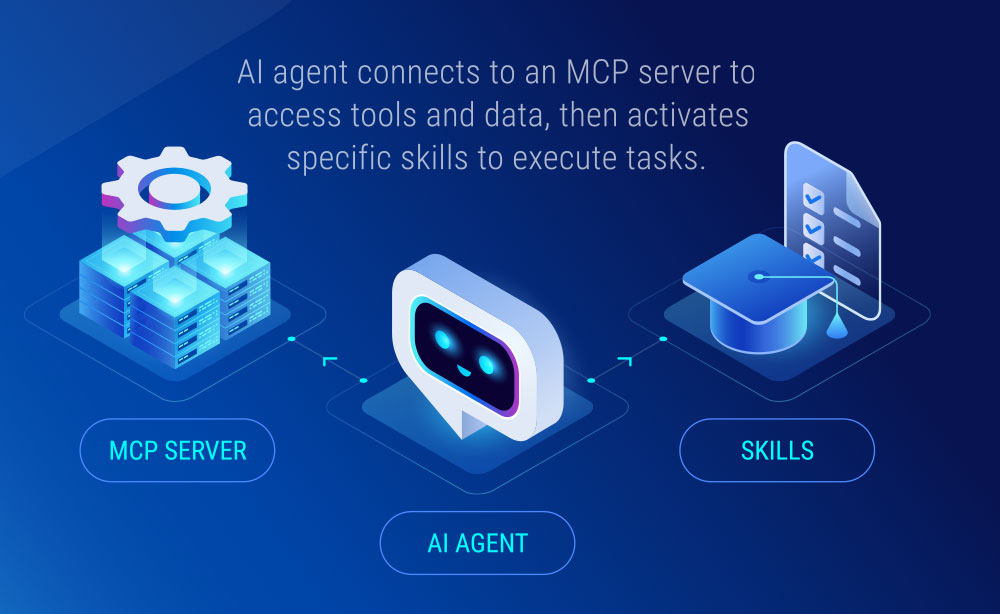
MCP is infrastructure for agentic AI — AI systems that perform tasks, not just answer questions. An AI agent that can connect to a calendar, email, project management tools, databases and external services is capable of doing actual work. Examples of what MCP-enabled AI agents can do: search for vendors, retrieve documentation, compare against requirements and book a demo as a single task; pull data from multiple sources, analyse it and update a report; trigger workflows across connected systems from one user instruction.

For this to work, tools need MCP servers. This is why Semrush, Ahrefs, Figma, Canva, Asana and Slack are building them — they want AI agents to use their software.

Why SEO tools are building MCP servers

“Semrush mcp” is at 170 monthly searches (+182% YoY). “Ahrefs mcp server” at 70 (+57% YoY). These are product decisions. SEO tools are responding to AI-assisted research workflows — agents pulling keyword data, clustering topics and producing briefs without manual export steps. This is a workflow efficiency shift for people doing SEO research. It does not improve visibility for the websites being researched. Confusing the two is the most common error in MCP discussions.

The security dimension

MCP introduces a genuine security concern: prompt injection. When AI agents access tools through MCP, malicious content in those tools can manipulate agent behaviour. Anthropic has published security guidance and patched vulnerabilities in its own MCP servers. For businesses evaluating whether to expose systems via MCP, security architecture is not optional — it is a prerequisite.

Should your business care about MCP?

Running SEO or content marketing: Understand it conceptually. It does not affect immediate visibility work but signals where AI agents are heading.

Building AI products or developer tools: MCP is relevant now. By 2026, MCP had reached 97 million monthly SDK downloads and over 10,000 published servers, with adoption by Claude, ChatGPT, Gemini, and Microsoft Copilot (Linux Foundation AAIF, 2026). The standard has enough adoption that building against it makes sense.

Running a SaaS or commercial platform: The medium-term question is whether AI agents will need to interact with your service programmatically. If so, how you expose capabilities will determine whether AI agents can use you.

Optimising for AI search visibility: MCP is not the priority. Fix entity corroboration, Bing indexing, content structure. Those address Layers 1–4 of the AI Discovery Stack. MCP addresses Layer 5 — which requires Layers 1–4 first.

A practical example: an outdoor living company that has scaled to seven-figure turnover through organic search did not get there by building MCP servers. It got there by being findable, trustworthy, and the clear answer to the right questions in the right semantic space. That is still the foundation. MCP is the layer that comes later, once the foundation is solid enough to build on.

The broader context: The Web Is Moving From Answers to Actions.

Key Definitions

Model Context Protocol (MCP)
A technical standard developed by Anthropic in 2024, adopted by major AI labs, that provides a consistent interface for AI models to connect to external tools, data sources and software systems. Analogous to USB-C for AI tool access — one standard connector instead of hundreds of custom ones.
MCP server
A software component that exposes the capabilities of an application or data source to AI models via the Model Context Protocol. An MCP server for a CRM allows an AI agent to query, create and update records without requiring custom API integration code.
N times M integration problem
The challenge that without a standard protocol, connecting N AI systems to M tools requires N multiplied by M custom integrations. MCP reduces this to N plus M by providing a single standard interface through which any AI can connect to any MCP-enabled tool.

How to Assess Whether MCP Is Relevant to Your Business

A structured process for determining whether and how MCP should feature in your AI strategy.

  1. 1

    Establish Phase Two foundations first

    Before evaluating MCP, confirm AI visibility fundamentals are in place: entity corroboration (Wikidata, Clutch, Crunchbase), Bing indexing, content structure for AI extraction. These address Layers 1–4 of the AI Discovery Stack. MCP addresses Layer 5 and requires the earlier layers as prerequisites.

  2. 2

    Identify your category in the MCP relevance matrix

    MCP is immediately relevant for AI product builders and developer tooling. Medium-term relevant for SaaS and commercial platforms where AI agents may interact programmatically. Background knowledge for SEO and content teams.

  3. 3

    Audit what AI agents would need from your ecosystem

    If an AI agent were evaluating your product or service, what information would it need? Is it structured and accessible? Consistent across platforms? This question is relevant regardless of MCP — it surfaces gaps in machine-readable presence that matter for agentic evaluation.

  4. 4

    Evaluate your API and integration surface

    If you run a SaaS or commercial platform, assess how your service exposes its capabilities. Well-documented public APIs and structured product data are the foundation. MCP servers build on top of that — they cannot substitute for it.

  5. 5

    Monitor without building prematurely

    The MCP standard is stable but tooling is still maturing. For most businesses, informed monitoring is the right posture now. Track which platforms in your category are building MCP servers. When the pattern is clear, the decision becomes easier.

Frequently Asked Questions

What does MCP stand for?

MCP stands for Model Context Protocol. It is a technical standard developed by Anthropic in 2024 and adopted by OpenAI, Google DeepMind and Microsoft. It provides a consistent interface for AI models to connect to external tools, data sources and software systems.

Does MCP improve SEO or AI search visibility?

No. MCP governs how AI agents connect to tools, not what content AI systems retrieve or recommend. Building an MCP server will not improve rankings, increase AI citation frequency, or help you appear in Google AI Overviews. The signals that determine AI visibility are entity corroboration, content structure, Bing indexing and domain authority.

Why are SEO tools like Semrush and Ahrefs building MCP servers?

SEO tools are building MCP servers to allow AI agents to access their data programmatically — enabling AI-assisted research workflows. This is a workflow efficiency play for people doing SEO research, not a mechanism that improves the visibility of the websites being researched.

Is MCP the same as an API?

No. An API is a method for one software system to communicate with another. MCP is a protocol — a standard defining how AI models specifically interact with tools. An MCP server is typically built on top of existing APIs, exposing their capabilities to AI models in a format the AI can use autonomously.

What are the security risks of MCP?

The primary security risk is prompt injection — where malicious content in a tool an AI agent accesses manipulates the agent's behaviour. Because MCP gives AI agents access to external systems, it creates new attack surfaces. Anthropic has published security guidance and patched vulnerabilities in its own MCP implementations. Security architecture is essential, not optional.

When will MCP matter for most businesses?

For AI product builders, now. For SaaS and commercial platforms, within two to three years as agentic AI matures. For most marketing and SEO teams, MCP is background knowledge contextualising where the AI ecosystem is heading rather than an immediate action.

Sean Mullins

Founder of SEO Strategy Ltd with 20+ years in SEO, web development and digital marketing. Specialising in healthcare IT, legal services and SaaS — from technical audits to AI-assisted development.

Ready to improve your search visibility?

Book a free 30-minute consultation and let's discuss your SEO strategy.

Get in Touch